Evidence · DPDP s.8, s.10 audits

Proof you can recompute.

Every consent decision and every rights-request step is a hash-linked record. The console verifies all of them on demand; the proof exports; the hash format is published, so an auditor can check it without us.

s.6(10) Burden of proofs.10(2)(b) AuditsPublished hash format
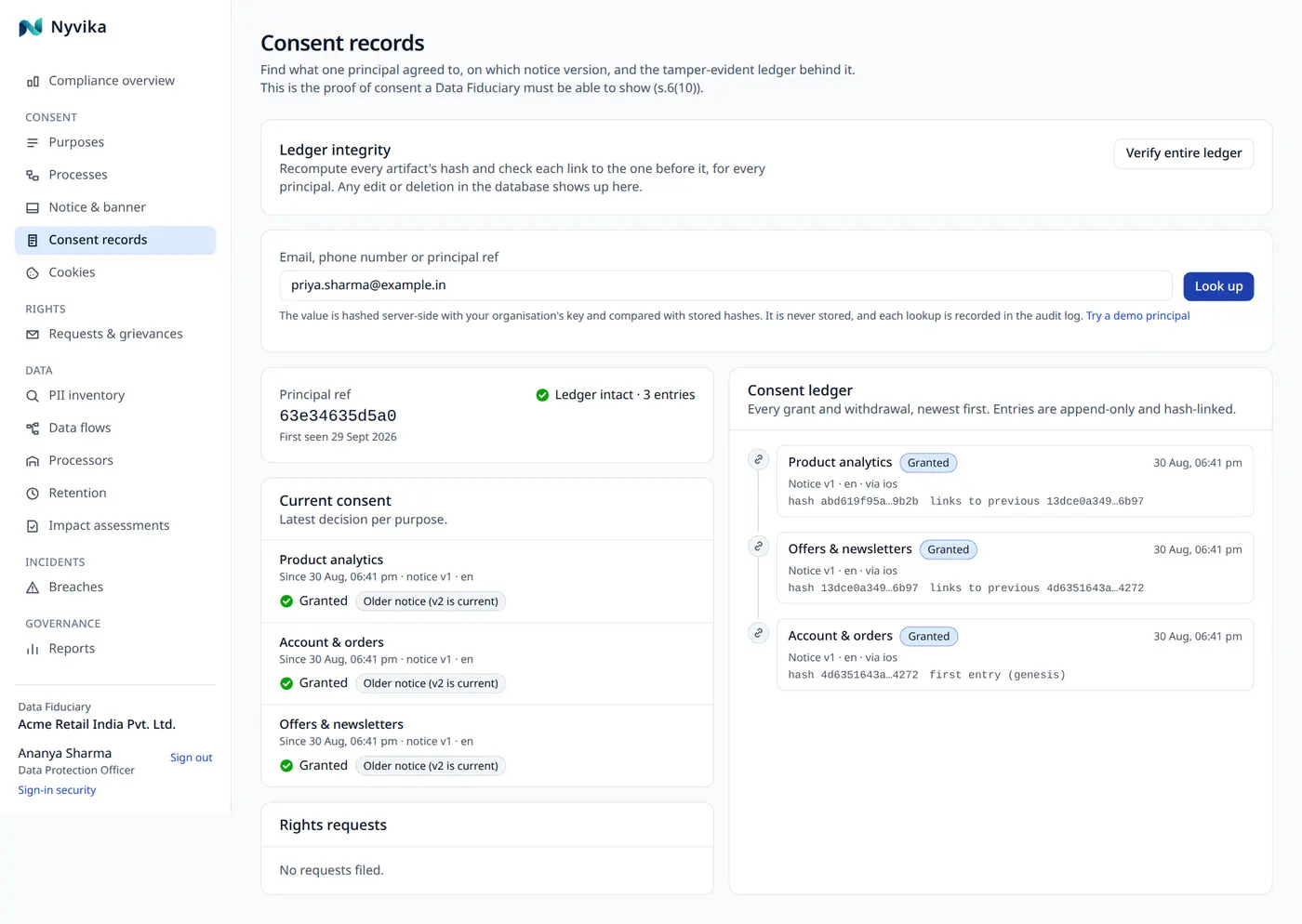
A person's consent record: hash-linked ledger entries and the verification result
The challenge

"Immutable" is a claim until someone checks.

Section 6(10) puts the burden of proving consent on the Data Fiduciary. A flag in a database, or a vendor's word, is not proof. A chain of hashes you can recompute is.

s.6(10)
You prove it, not the person
When consent is disputed, the fiduciary must show the notice given, the choice made and the time. The record has to pre-date the dispute and be shown not to have changed.
Edited records
A database row can be rewritten
An ordinary table of consents can be altered by anyone with access, including after a complaint. Evidence needs to make alteration detectable.
Vendor lock
Proof that lives only in someone else's product
If the only way to verify a record is to trust the vendor that stores it, you have outsourced your proof.
What Nyvika does

Chains, reports and a score.

Evidence is not a module bolted on; every other part of Nyvika writes to it.

Hash-chained ledger

Each consent entry hashes the person, purpose, status, notice version, language, source, channel, process, time and the previous entry.

  • Two chains: per person and per organisation
  • Rights requests have their own chained timeline
  • Erasure redacts content, preserves the chain
Verification

One click recomputes every chain; a person's record page verifies theirs.

  • Ledger-proof report exports the result
  • Hash construction documented with test vectors
  • Verifiable offline, without Nyvika

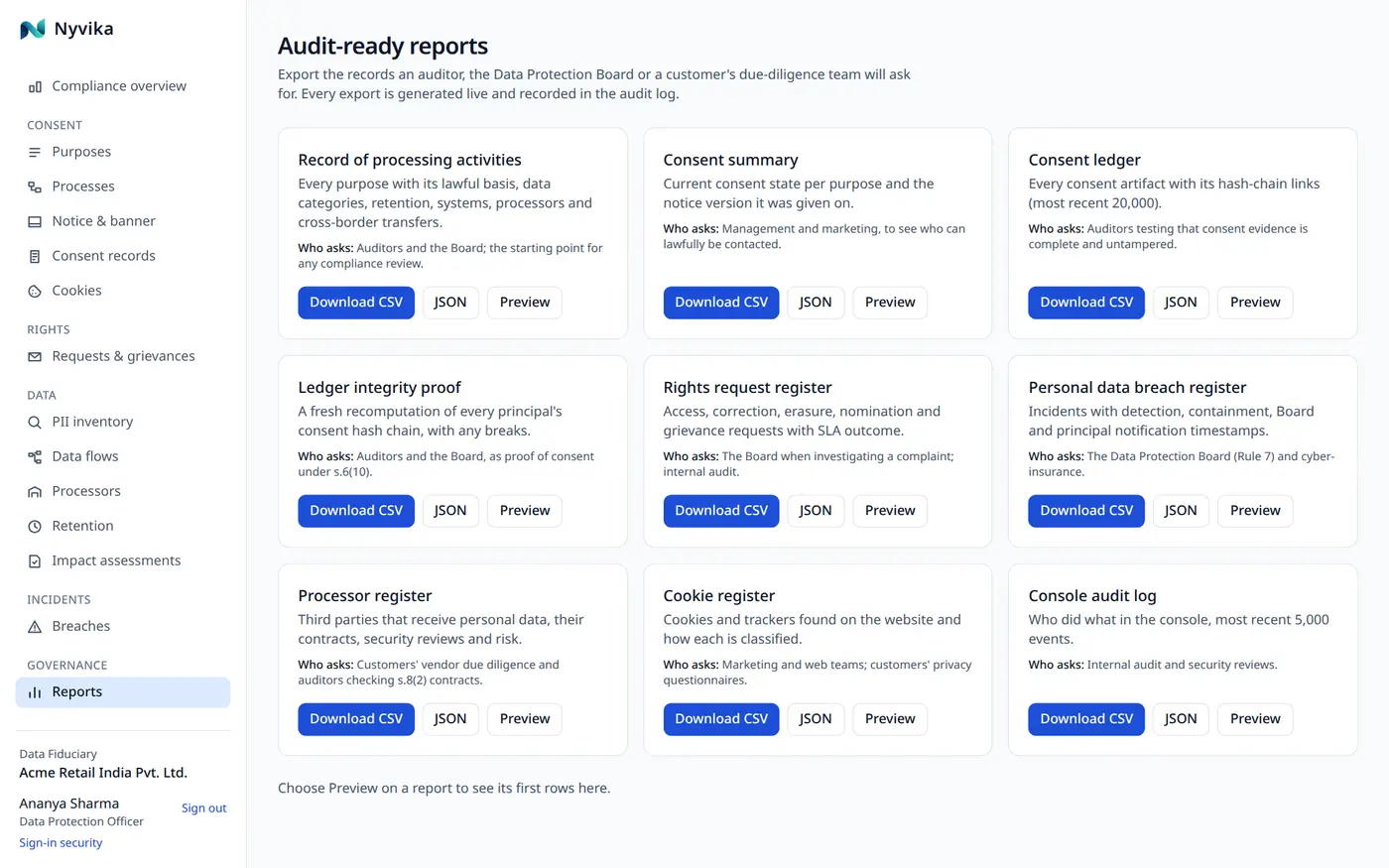
Nine reports

Record of processing, consent ledger, consent summary, request register, breach register, processor register, cookie register, audit log, ledger proof.

  • CSV or JSON
  • Generated from the live registers
  • Report generation is itself audited

Compliance score

Notice coverage, consent health, requests in time, breaches reported in time, processor agreements, with published weights.

  • Shown on the overview with what to fix
  • No black box
  • History over time
Blind by design

Evidence without exposure.

The ledger identifies people by keyed hashes. Email addresses and phone numbers live only in an encrypted vault, decrypted to act on the person's own instruction and shredded after erasure.

  • Keyed hashes

    Identifiers are hashed with your organisation's own secret; the ledger holds no addresses.

  • Encrypted vault

    Contact addresses and connector credentials are encrypted at rest and never logged.

  • Audit log

    Every console action, by whom, from where, when: exportable as the audit log report.

The reports page: nine audit-ready exports
One ledger

How it connects.

Every module writes to the same registers and the same hash-chained evidence, so nothing is re-keyed and nothing is lost between teams.

Questions

Asked about evidence.

How would our auditor verify the ledger without you?

Export the consent ledger and the ledger-proof report, take the documented hash construction (a short note with test vectors that we share with your auditor), and recompute. If any entry had been altered, the chain breaks at that point.

Is the ledger digitally signed?

It is HMAC-chained with your organisation's key. A periodically signed anchor with an asymmetric key is on the roadmap so that verification also survives a full database restore.

Where does the evidence live?

In Nyvika's service, in your organisation's partition, hosted in India. Everything exports as CSV or JSON whenever you want a copy outside.

Still have a question? Write to us.

Ask any vendor to show you this.

In the demo we verify the ledger in front of you, export the proof and recompute one hash by hand.